What Does Cajeput Oil Smell Like? A Scent Guide
Uncap a bottle of cajeput and the first thing you meet is a cool, camphor-edged lift, the kind that makes you tilt your head back an inch. Wait a few seconds and something sweeter and almost fruity drifts in behind it. We describe our oil as fresh, cool and fruity-camphorous, and that small journey from sharp to soft is the whole personality of the scent.
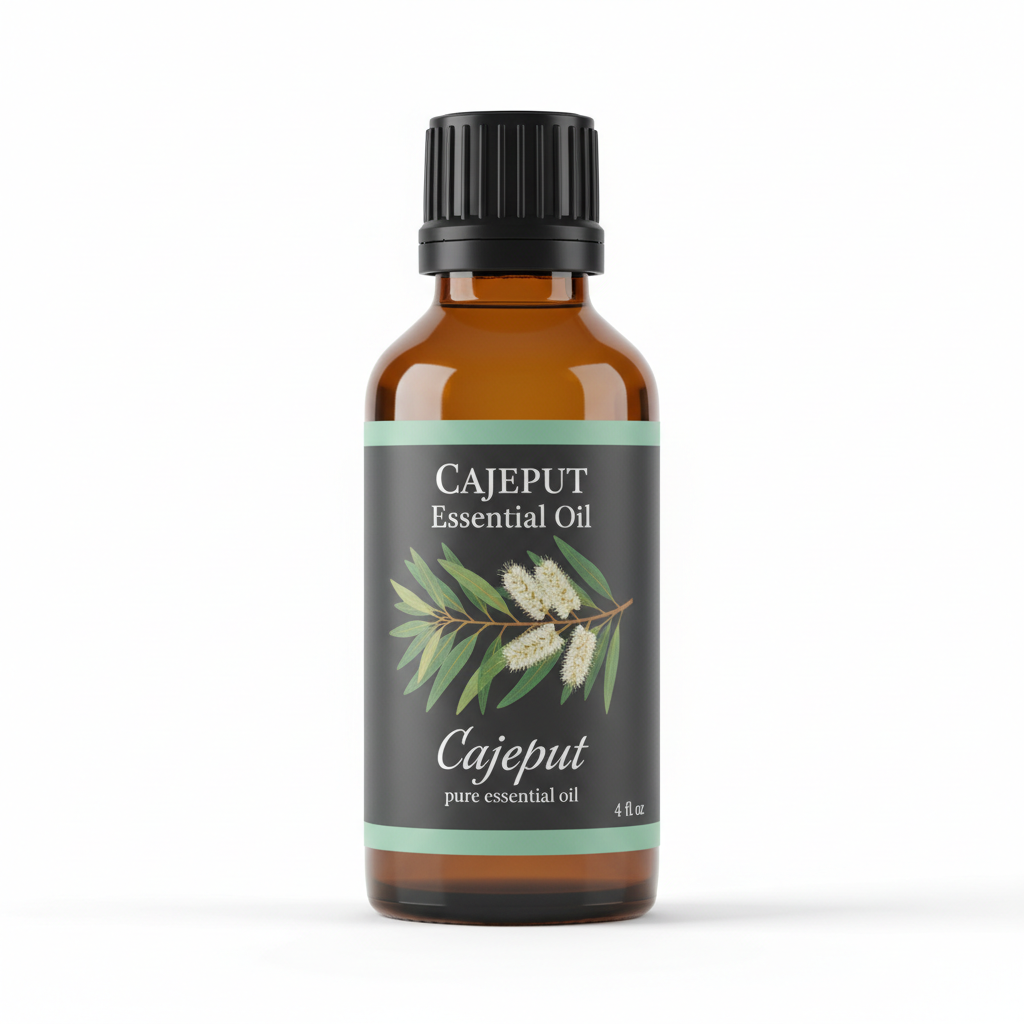
Cajeput Essential Oil
Our own Cajeput Essential Oil, in sizes from 0.5 oz to bulk.
From $10.99
Shop Now →The sharp edge: 1,8-cineole
The biggest single ingredient in cajuput oil is 1,8-cineole, also called eucalyptol, and its recorded odour is "camphor-like" (PubChem, drawing on Hawley's Condensed Chemical Dictionary). That is the cool, clean-cut note you notice first. Across five batches in the 2024 EFSA assessment of cajuput oil, cineole averaged about 61 percent, inside a specification of 50 to 70 percent. It is a lot of one molecule, which is why cajeput smells so decisive. We go deeper on the chemistry in the cineole post.
The sweet part: terpineol and limonene
Underneath the cineole sit two supporting players. Alpha-terpineol is described as floral with a lilac note (PubChem), and limonene as pleasant and lemon-like (PubChem). EFSA lists both among cajuput's main components, at roughly 8 and 6 percent. It is reasonable to think that is where the sweetness and the hint of fruit come from, and it fits what we hear in the bottle: a sharp top with a softer, rounder finish.

The Certificate of Analysis we publish for one batch gives the smell as "Sweet, Sharp, Fresh", which is a neat three-word summary of the same experience.
Words you might reach for
People describe the same smell in very different ways, and it can help to have a few words ready. For cajeput, try these. Cool, for that first lift. Sharp, for the clean edge. Fruity, for the sweeter note that follows. Fresh, for the overall feeling. If you are the sort of person who likes to jot things down, write your own words beside the lot number and compare them next time. You may find your list changes as your nose gets used to the oil.
It is also fun to ask a friend. Hold a strip out and ask what it reminds them of, before you say a word. Noses differ, and what is "sweet" to one person is "sharp" to another.
A better way to smell it
Cajeput's first impression is its sharpest and most volatile, so a deep sniff from the bottle tells you less than you would expect, and the oil can sting if it touches eyes or broken skin. A gentler routine shows you much more:
- Hold the bottle at arm's length and waft rather than sniffing close.
- Put a drop on a paper blotter or a strip of plain cardstock instead of on skin.
- Come back at three moments: straight away, after a few minutes and after an hour.
- If you like, set a eucalyptus strip beside it. The family resemblance is obvious, and so is the extra sweetness in cajeput.
By the hour mark the camphor edge has usually settled and the rounder notes have room to speak. That is the smell you will actually live with in a room.
Why one bottle may not smell like the next
Cajeput is a plant oil, so lots vary. Leaf from different trees and places gives a different balance of cineole and the sweeter compounds, and EFSA notes that two Melaleuca species are commonly mixed before distillation. A slightly sharper or softer lot is ordinary. If you ever want more than a nose can tell you, you can ask us in writing through the contact page about the report for your lot.

Cajeput beside its neighbours
With eucalyptus it shares its main compound, so the cool backbone is familiar. Tea tree is a different animal: in a 2023 survey of retail Melaleuca oils, tea tree was built on terpinen-4-ol where cajeput was built on cineole (Vazquez et al.), and our tea tree comparison shows how different they smell. Camphor oil is the other relative, covered in its own post.
Where you will meet it in a room
In a room, cajeput tends to show up as a quick, clean opening rather than a lingering backdrop. You will notice it when you first walk in, and then it quietly becomes part of the air. That is exactly why it suits entryways, hallways and bathrooms. If you notice it constantly after half an hour, you have probably used a drop or two too many, and the fix is simply to use less next time.

Where it fits in a blend
We think of cajeput as a top note, which is why it pairs so easily with citrus, lavender, pine, rosemary and peppermint. Our advice is to use less than you think: with so much of one sharp compound, a little goes a long way, and a second drop is easier to add than to take back out. The blending guide shows how.
A fresh, cool scent is a pleasure of its own, and that is all we claim for it. Take your time with the blotter and let the sweetness arrive.
Cajeput Essential Oil
Cajeput Essential Oil from our own shop, in sizes from 0.5 oz to bulk.
From $10.99
Shop Now →Sources & Further Reading
- PubChem, 1,8-Cineole, odor entry: pubchem.ncbi.nlm.nih.gov/compound/2758
- PubChem, alpha-Terpineol, odor entry: pubchem.ncbi.nlm.nih.gov/compound/17100
- PubChem, Limonene, odor entry: pubchem.ncbi.nlm.nih.gov/compound/22311
- EFSA FEEDAP Panel, 2024. Cajuput oil for use in all animal species. EFSA Journal 22(4):e8732: PMC11004901
- Vazquez A, Tabanca N, Kendra PE, 2023. Melaleuca essential oils, Molecules 28(9):3925: PMC10180325