Cajeput vs Camphor Oil: Same Cool Smell, Different Oils
Put "cajeput oil" and "camphor oil" side by side on a supplier's list and they look like neighbours, both cool and sharp and vaguely medicinal to the nose. They are not close relatives chemically, and one of those two names hides far more variety than the other. For scent, we would start with cajeput, and treat "camphor oil" as a label you need to decode first.
Cajeput Essential Oil
Our own Cajeput Essential Oil, in sizes from 0.5 oz to bulk.
From $10.99
Shop Now →Camphoraceous is a scent word
Camphor itself is one specific compound, a ketone. The leading compound in the cajeput samples we could find is 1,8-cineole, an oxide: about 65% in one retail oil analysed in 2023, and around 53% in leaf oil from Tamil Nadu in a 2024 study. So cajeput smells camphor-like to many noses because of a different molecule. Grouping the two as "camphoraceous classics" is fine as a perfumer's shorthand and misleading as chemistry. When we call our cajeput fresh, cool and fruity-camphorous, we are describing its aroma, not its composition.
Which tree is the camphor oil from?
Camphor oil comes from the camphor tree, Cinnamomum camphora, and a large 2023 study shows why the name alone tells you little. Researchers distilled oil from 974 trees across 35 populations in 13 Chinese provinces and found the oils sorted into six main chemotypes: eucalyptol, nerolidol, camphor, linalool, selina and mixed. The eucalyptol-type trees gave the highest oil yield.
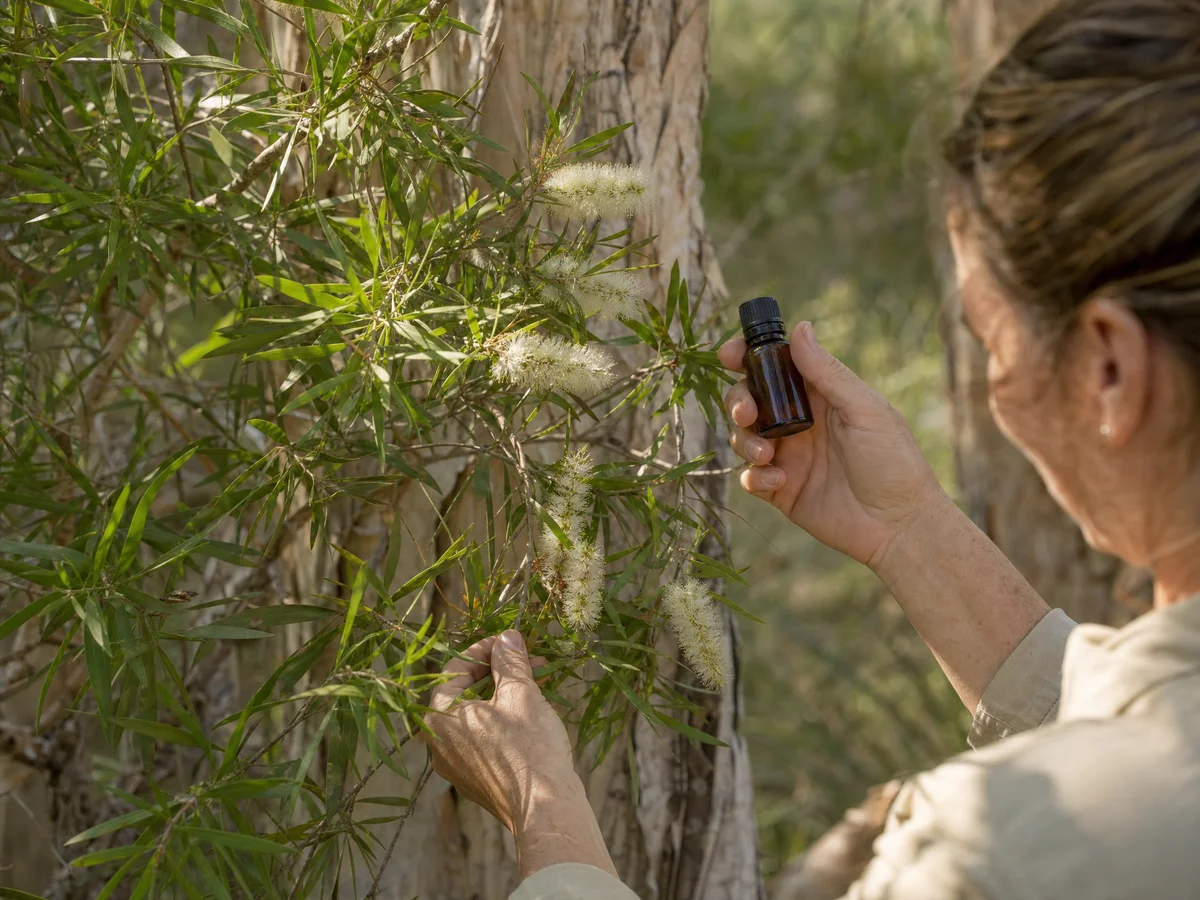
That means a bottle labelled "camphor oil" might be led by camphor, by eucalyptol (the same molecule as 1,8-cineole), or by linalool. Those are three different oils sharing one name. Without a chemotype or an analysis on the label, you cannot know which you bought, and neither can we from here. Cajeput lots differ too, as the two samples above show, but the sources we found point to one dominant compound, where camphor tree oil has at least six possibilities to rule out.
Reading a supplier list
When you see "camphor oil" on a list, slow down for a minute. Look for the Latin name, the plant part and any note on the type of oil, and see whether the seller shares an analysis for the lot. If the listing is only two words long, that is your cue to ask a question before you order. Cajeput's single species name makes this much simpler, which is part of why we like it as a starting point for a cool, sharp top note.
If you do end up with both bottles on the same shelf, label them clearly and keep them in separate spots. Two oils that smell alike in the dark are easy to mix up.
Settle the safety question before the scent one
The camphor ketone carries a serious toxicology record in small children. A 2004 review in the Journal of Emergency Medicine reports that as little as 500 mg of camphor has been linked to death in children, and advises rapid medical triage for a child under 6 exposed to that amount or more. That paper is about camphor in consumer products, not about every camphor-tree oil and not about cajeput. Cajeput deserves care of its own: it is high in cineole and not suitable for babies and young children, as we explain in our children post. The takeaway is that we would not recommend a camphor-led oil on the strength of a scent comparison. If you are weighing one, keep it away from toddlers and ask a pharmacist before buying, and call poison control after any exposure.
Choosing by the scent you want
- A cool, cineole-led top note. Cajeput does this, and it has a single species name to check. A eucalyptol-type camphor oil may land in the same place, but you would need the analysis.
- A heavier, more medicinal note. That is the camphor-led oil. We do not sell it, and we would want the chemotype and lot report in hand before suggesting it for a home with children.
- A softer, floral-leaning note from the same tree. The linalool type is a different scent altogether and no swap for either of the others.
The oils we list as good partners for cajeput are eucalyptus, pine, lavender, citrus, rosemary and peppermint; camphor is not among them. Our blending guide shows how those pairings work, and our rosemary comparison covers another oil whose chemotype changes how camphor-like it smells.
A simple way to compare by nose is to put a drop of each on its own paper strip and wave them past you at arm's length, not close to your face. Smell them straight away, then again after a few minutes. Camphor-led oils tend to read drier and heavier, while cajeput has that sweeter, fruitier turn behind the first cool lift. Keep the strips away from eyes and from small children.
About our own cajeput
We sell one cajeput oil, steam-distilled, in nine sizes, neat and undiluted. The Certificate of Analysis for our current batch lists relative density 0.906, refractive index 1.469 and optical rotation +2.32 degrees, concluding that the parameters comply with pharmacopoeia standards for genuine cajeput oil. It has no cineole or camphor figure, and if you need one for your lot, ask us in writing through the contact page. Larger sizes are listed on our bulk page, and our guide to buying cajeput in bulk explains what to check before you order. Our dilution guidance of 0.5% to 2% in a carrier with a patch test first applies to cajeput only; for a camphor-type oil, dilution is a question for a certified aromatherapist or pharmacist using that oil's own analysis.

If you are choosing between two bottles, the simplest rule is to prefer the one whose label you can fully decode.
Cajeput Essential Oil
Cajeput Essential Oil from our own shop, in sizes from 0.5 oz to bulk.
From $10.99
Shop Now →Sources & Further Reading
- Vázquez A, Tabanca N, Kendra PE, 2023. HPTLC analysis and chemical composition of selected Melaleuca essential oils. Molecules. PMC10180325
- Vivekanandhan P et al., 2024. Biocontrol efficacy of cajeput oil against Anopheles stephensi. Front Physiol. PMC10941012
- Zhang T et al., 2023. Chemical variation and environmental influence on essential oil of Cinnamomum camphora. Molecules. PubMed 36770639
- Love JN, Sammon M, Smereck J, 2004. Are one or two dangerous? Camphor exposure in toddlers. J Emerg Med. PubMed 15219304