Cajeput vs Eucalyptus Oil: Which Should You Use?
If all you want is a clean, cool top note in a room spray or diffuser blend, cajeput and eucalyptus will often be interchangeable enough that availability decides it. The more interesting difference is predictability. "Eucalyptus" on a label can mean any of hundreds of species, and the species changes what is in the bottle.
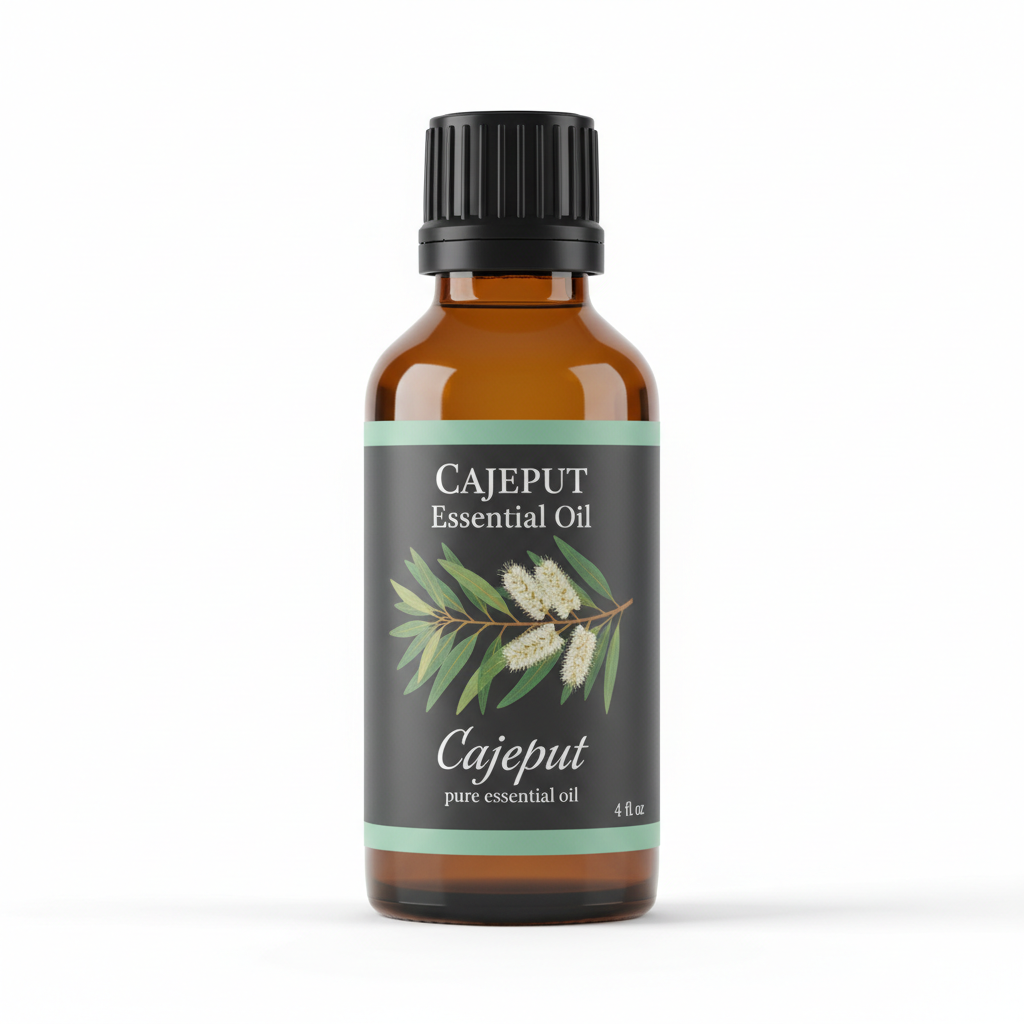
Cajeput Essential Oil
Our own Cajeput Essential Oil, in sizes from 0.5 oz to bulk.
From $10.99
Shop Now →One shared molecule
Both oils are built around 1,8-cineole, also called eucalyptol. A 2016 review of leaf-oil studies covering 68 Eucalyptus species from 27 countries calls E. globulus oil the major commercial source of 1,8-cineole, with samples above 80% in Australia, Indonesia, Italy and India. Cajeput sits in the same family of scent at a lower level in the samples we found: about 65% in one retail oil analysed in 2023 and around 53% for Tamil Nadu leaf oil in 2024, with limonene and pinenes alongside. Eucalyptus has its own limonene and pinene, so the minor notes overlap as well.
What follows is reasoning from composition, not a sensory study: with the same main molecule and overlapping minor terpenes, the two should read as the same scent family, and a high-cineole eucalyptus will sit closer to cajeput than a low-cineole one. Where they part ways is in the details. We describe cajeput as fresh, cool and fruity-camphorous, a little brighter and sweeter than many leaf oils, and the best way to judge the difference for your own project is to put a drop of each on a blotter.
Where eucalyptus is the less certain buy
The same review that gives 90% for the best samples also lists leaf oils with far less cineole (the table runs from about 17% to 90%), and some species are not cineole-led at all. A seller who writes only "eucalyptus oil" has told you very little. Four questions fix that: which species, in Latin; which country and year; is there a GC-MS report for this lot showing cineole as the main compound; and has the oil been rectified or standardised.
Cajeput has the same issue on a smaller scale. A single species is on the label, and both samples above were cineole-led, yet lots still differ by about a dozen points. We sell our oil as cajeput, never relabelled as eucalyptus and never blended toward it. The Certificate of Analysis for our current batch names Melaleuca cajuputi, leaf, steam distilled, with relative density, refractive index and optical rotation within standard. Those are identity checks and not a composition profile, so if your project depends on a cineole range, ask us in writing through the contact page before you commit to a large size.
Which one for which job
- Diffuser or room spray where the cool note sits on top: either works. Eucalyptus is first on our list of oils that blend well with cajeput, but the pair will stress the same note instead of adding contrast. For contrast, start with our blending guide.
- A recipe that says eucalyptus when you have cajeput: our substitutes post covers what changes and what to re-check.
- Anything for a cold, cough or blocked nose: that is a question for a pharmacist or physician. We sell cajeput as an aromatic and cosmetic oil.
Think about the room, not the bottle
It helps to picture where the scent will live. A small bathroom with the door shut, a workshop, an entryway and a living room all behave differently, and the same few drops will read as faint in one and loud in another. In a small closed room, start with less and let your nose tell you whether to add. In a big open room, a short run will often do more than a long one. Either oil follows these rules, so the real question is which cool note you want to walk into.
If you already own eucalyptus and are wondering whether to bother with cajeput, a paper strip answers it in a minute. Smell both side by side, and pay attention to the second half of the smell, when the sharp opening fades. That is where cajeput's slightly sweeter, fruitier turn shows, and where you decide whether you like it.
The safety point they share
High-cineole oils are strong, and neither is for swallowing. Public-health guidance and the European authorities both single out cineole-rich oils for care around small children: Western Australia's health department warns that as little as 2 mL of eucalyptus oil can seriously poison an infant, and ANSES in France advises against cineole-rich cajeput and niaouli oils for children, and for pregnant or breastfeeding women. So with either oil, keep bottles out of reach of children and pets, dilute for skin, and call poison control or a physician or veterinarian straight away if one is swallowed. Our swallowed oil post has the steps, and our dilution guidance for cajeput is 0.5% to 2% in a carrier with a patch test first. An oil with a higher cineole share deserves at least the same care.
So our verdict is to choose on label clarity and on what you can verify. We sell one cajeput and do not sell eucalyptus, so for that, look for a supplier that names the species and shares a lot analysis.
Cajeput Essential Oil
Cajeput Essential Oil from our own shop, in sizes from 0.5 oz to bulk.
From $10.99
Shop Now →Sources & Further Reading
- Barbosa LC, Filomeno CA, Teixeira RR, 2016. Chemical variability and biological activities of Eucalyptus spp. essential oils. Molecules. PMC6273930
- Vázquez A, Tabanca N, Kendra PE, 2023. HPTLC analysis and chemical composition of selected Melaleuca essential oils. Molecules. PMC10180325
- Vivekanandhan P et al., 2024. Biocontrol efficacy of cajeput oil against Anopheles stephensi. Front Physiol. PMC10941012
- Healthy WA. Essential oils. healthywa.health.wa.gov.au
- ANSES, 2020. Food supplements containing tea tree, niaouli and cajeput essential oils: their misuse can be dangerous. anses.fr