DIY Cajeput Shower Steamers Without the Slippery Floor
The fizz in a shower steamer is not where the scent comes from. Baking soda and citric acid make the bubbles, and they would do it just as loudly with no oil at all. The cajeput is a separate passenger on the same trip, and the interesting question is how to get it from the puck to your nose without leaving a slick on the shower floor.
Cajeput Essential Oil
Our own Cajeput Essential Oil, in sizes from 0.5 oz to bulk.
From $10.99
Shop Now →The fizz is arithmetic
Citric acid has three acidic groups, so one molecule neutralises three molecules of sodium bicarbonate and releases carbon dioxide as it goes. Convert that to grams and you get a ratio of about 0.76 g of anhydrous citric acid for every gram of bicarbonate (192.12 g/mol against 3 x 84.01 g/mol). Many craft recipes use two parts baking soda to one part acid instead, which leaves roughly a third of the soda with nothing to react with. It does no harm, but it is dead weight in the puck.
A balanced 50 g puck, worked out on paper from those molar masses, looks like this:
- 19.0 g citric acid (anhydrous; use a little more if yours is the monohydrate)
- 25.0 g sodium bicarbonate
- 0.5 g cajeput, which is 1% of the puck
- 1.0 g polysorbate dispersant (more on that below)
- A few grams of binder, added by the spritz
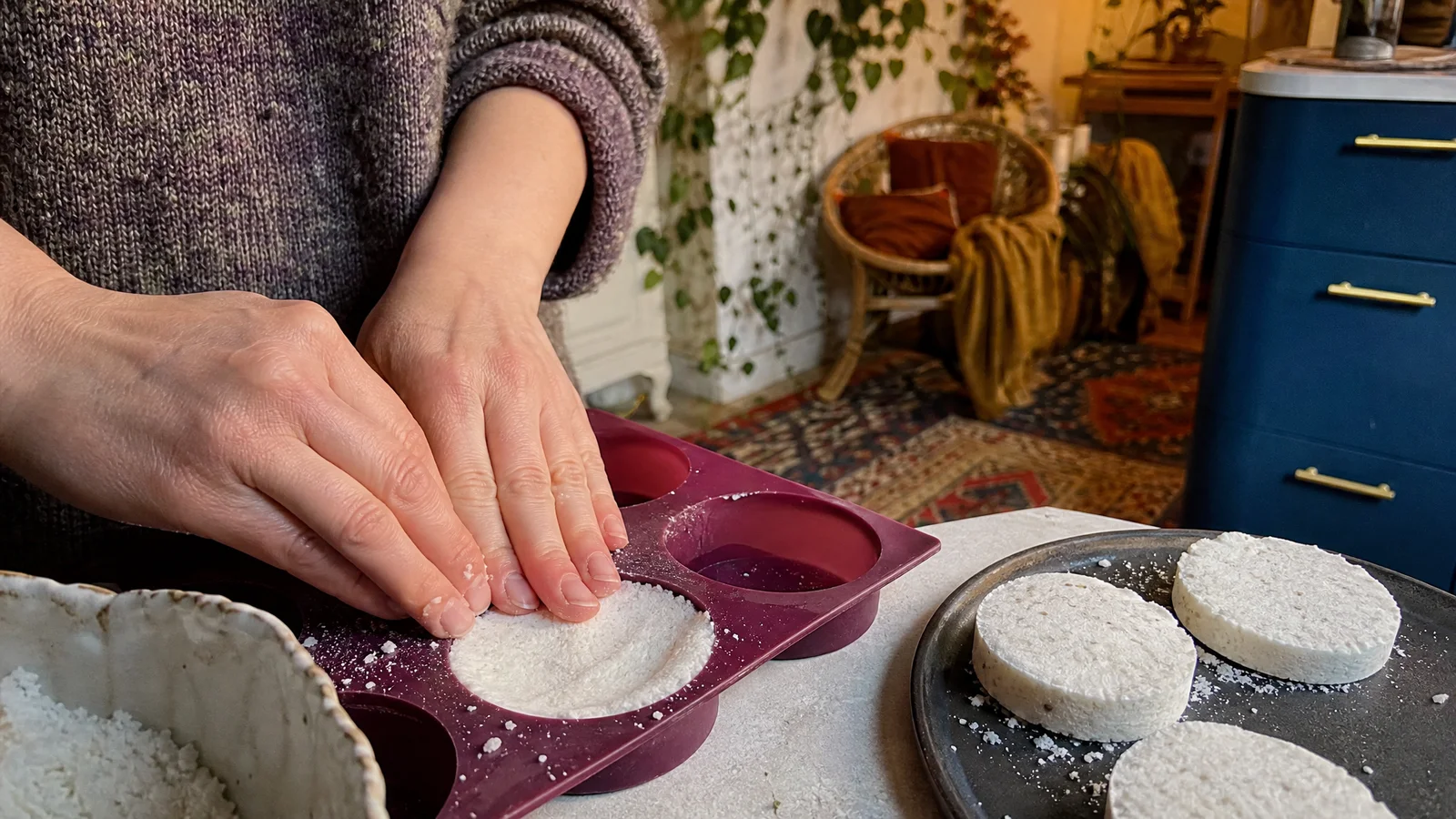
Go easy on the binder. Water is what sets the reaction off, so every spray of water or witch hazel turns a little of your fizz into sodium citrate before the puck ever sees the shower. Use the fewest sprays that let a squeezed handful hold its shape, dry the pressed pucks for a day, and keep them in a sealed jar away from the tub. The bathroom is the wettest room in the house, and a jar on the edge of the bath is the worst place for them.
Oil and water, and the dispersant that introduces them
Here is the part most recipes skip. Cajeput will not dissolve in water, so when the puck fizzes, the oil is released into a film of water it cannot mix with. Some of it travels to the drain and some of it can end up coating the floor of the stall.
A dispersant is the fix. Polysorbates such as polysorbate 20 and 80 are the sort of surfactant that Tisserand's bath safety guidance points to for exactly this reason, since essential oils are not water soluble. Stir the cajeput into the dispersant first, then work that mixture into the citric acid before the bicarbonate goes in. Your supplier's data sheet will give a recommended ratio for their product; as a starting point for the arithmetic, we would weigh two parts dispersant to one part oil.
You can check it before you step into a shower. Drop one puck into a bowl of warm water, let it finish, and look at the surface under a lamp. Beads or a sheen mean the oil is not being held; an even, slightly cloudy haze means it is. If you see oil, raise the dispersant in the next batch rather than reaching for a spoonful of carrier oil. Carrier in a shower puck makes the floor slippery on purpose, and the bathroom is already where falls happen: the CDC counted about 234,000 emergency department visits for bathroom injuries among adults in 2008, with falls behind roughly four in five and the tub or shower the highest-rate location (Stevens et al., CDC MMWR, 2011).
How much cajeput belongs in a puck
Less than you think. A puck dissolves at your feet in a small, closed stall, so a heavier hand means a stronger exposure rather than a better one. We recommend keeping to our 0.5% to 2% skin range by puck weight and starting low, which is why the formula above sits at 1%, or 0.5 g.
In drops, 0.5 g of the batch on our Certificate of Analysis (specific gravity 0.906) is about 0.55 ml, and the Tisserand Institute reports that drops per ml range from roughly 20 to 40 depending on the dropper. That puts you anywhere between 11 and 22 drops, which is a good reason to weigh it on a 0.01 g scale. A dispersant and the other powders are easy to find at a craft or soap-making supplier; we sell the cajeput.
Who should sit this one out
A shower steamer is an aroma and bath product, and we make no claim that it does anything for your chest or breathing. If you have asthma or reactive airways, check with your physician before filling a small stall with a cineole-rich scent, and if you have a cough or breathlessness that will not shift, that is a doctor's question, not a steamer's.
Cajeput is high in 1,8-cineole, and we do not recommend it for babies and young children. The European Medicines Agency's page on eucalyptus oil medicines says they must not be given to children under 30 months and lists inhaled, skin and bath-additive forms for ages four and up (EMA). That is about eucalyptus, so applying it to cajeput is our reasoning, but the shared constituent makes it an easy one. Skip the puck in any shower a baby or toddler shares, and keep pucks away from children and pets. Our piece on children and cineole explains where the rule comes from, and if you like this style of project, the linen spray and the shower and sauna guide are good next stops.
A last small pleasure: when a steamer is made well, you can open the jar and catch a faint, cool note even before the shower runs. That is the moment you know the batch is right.
When the shower is over, rinse the floor with plain water and run a foot across it before you step out. It is a ten-second habit, and it does more for you than anything in the puck.
Cajeput Essential Oil
Cajeput Essential Oil from our own shop, in sizes from 0.5 oz to bulk.
From $10.99
Shop Now →Sources & Further Reading
- Tisserand Institute. Bath safety. tisserandinstitute.org/safety/bath-safety
- Stevens JA, Haas EN, Haileyesus T, 2011. Nonfatal Bathroom Injuries Among Persons Aged 15 Years and Older, United States, 2008. CDC MMWR. cdc.gov
- Tisserand Institute. How big is a drop? tisserandinstitute.org/learn-more/drop-size
- European Medicines Agency. Eucalypti aetheroleum (herbal medicine summary page). ema.europa.eu