Cajeput Blends: Four Pairings and Why They Work
Cajeput pairs best when you decide what each oil is for before you start counting drops. In every blend below, cajeput is the small bright accent: a single cool point in a warm or floral picture, never the star. Here are three diffuser pairings and one skin version, each with drops and a reason for its shape.
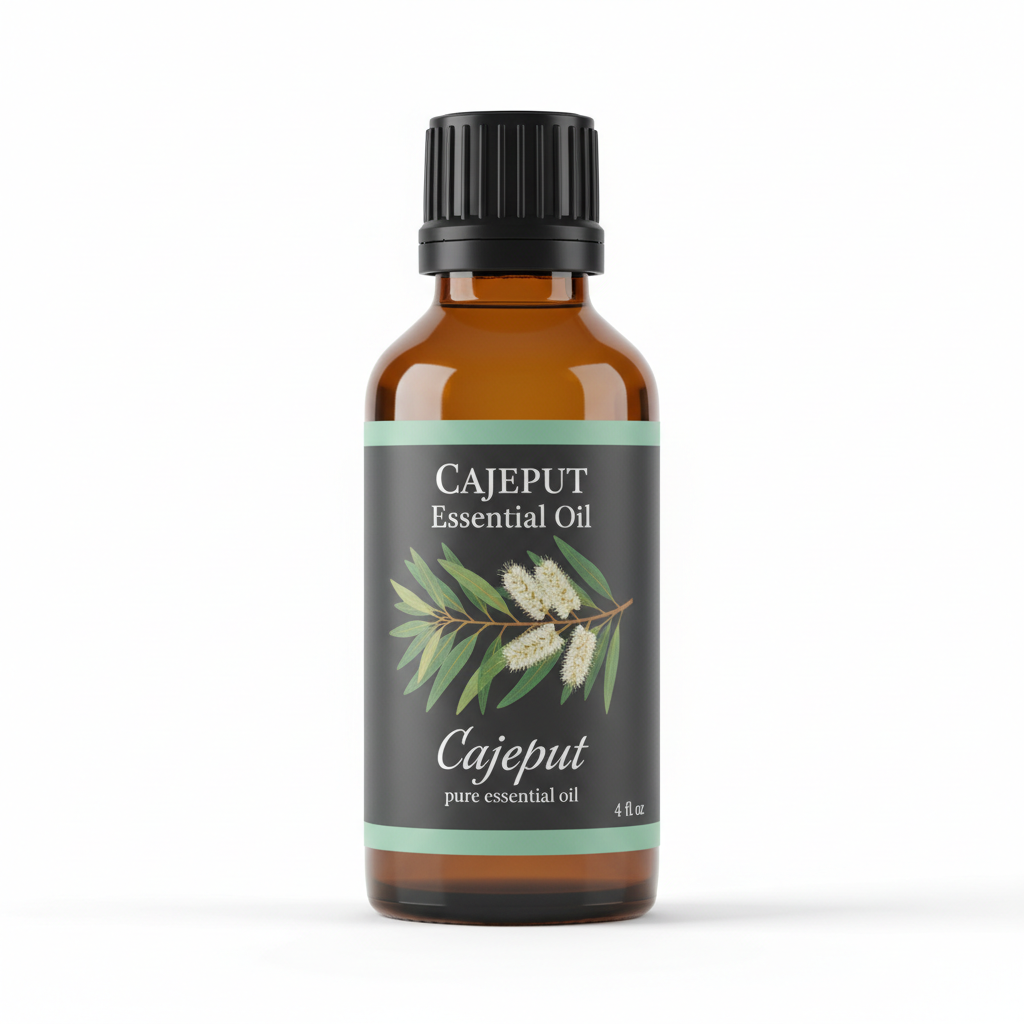
Cajeput Essential Oil
Our own Cajeput Essential Oil, in sizes from 0.5 oz to bulk.
From $10.99
Shop Now →Rules all of them follow
Cajeput is the smallest part, never the largest. We describe it as a top note with a fresh, cool, fruity-camphorous aroma, and it is rich in 1,8-cineole, which averaged about 61 percent in five batches in the 2024 EFSA assessment. That is a general figure for cajuput oil, but it explains why a drop goes so far.
Keep sessions short. The Tisserand Institute suggests diffusing for 30 to 60 minutes, then pausing for 30 to 60 minutes, with fresh air (safety guidelines).
Think in a 10-drop stock mix. Scale to your diffuser manual's total. Drops run from roughly 20 to 40 per millilitre (Tisserand Institute), so treat the numbers as ratios, not doses. We sell one cajeput oil and no blends, so everything here is built on paper from how the scents behave.
A quick note on how to use these. Smell the oils one at a time on paper strips before you blend, and notice how each behaves: orange is round and juicy, cedarwood dry and quiet, lavender soft and herbal, geranium rosy and a little green. Once you know the characters, the recipes make more sense, because you can hear the roles each oil plays.
1. Cajeput, sweet orange and cedarwood: dry and warm
Per 10 drops: 1 cajeput, 5 sweet orange, 4 cedarwood.
It smells like lifting the lid of a cedar chest: a bright opening over a dry, woody base. The wood comes from compounds like cedrol, which PubChem records as "woody-earthy" (PubChem, cedrol). Cajeput sits at one part in ten because the base is quiet, and a louder cajeput would sit on it like a lid. Orange carries the middle, cedarwood anchors it. Choose this when you want a room to smell warm with cajeput noticed mostly by its absence.
2. Cajeput, lavender and geranium: floral with a cold edge
Per 10 drops: 1 cajeput, 5 lavender, 4 geranium.
Rose-leaning florals with one cool point running through them. Two sweet florals can turn cloying, and a drop of something sharp gives the nose a place to rest. If you can name cajeput in the finished smell, you used too much; use fewer drops, and see our diffuser post for the fix.
3. Cajeput, juniper berry and grapefruit: green and bright
Per 10 drops: 2 cajeput, 3 juniper berry, 5 grapefruit.
This one is closer to the garnish on a gin and tonic than to a spa: green, resinous, bitter-bright. Cajeput gets two parts here because juniper and grapefruit are both light and need a little body. Two in ten is still well below the one-in-three of the cool, clean accord in our blending guide. All three oils are terpene-rich, so keep the session short and a window ajar.
4. Pairing 2 on skin, as a body oil
A diffuser recipe cannot simply be moved onto skin, so this one is worked out separately. For about 30 ml of carrier oil: 1 drop cajeput, 5 drops lavender, 3 drops geranium. Those 9 drops come to about 0.3 ml at 30 drops per millilitre, or roughly a 1% blend (somewhere between 0.75% and 1.5% depending on your dropper).
That sits inside our own guidance of 0.5% to 2% in a carrier oil for skin. The Tisserand Institute lists 1 to 3% for body oils, 0.5 to 1.2% for facial products and 0.2 to 1% for sensitive or impaired skin, and stresses that the total across all oils is what counts (Tisserand dilution). Use jojoba or sweet almond (skip sweet almond for anyone with a nut allergy) from a carrier supplier, keep it water-free, and patch test first. DermNet NZ explains that patches stay on for 48 hours with a reading at 96 hours, because reactions typically appear between 48 and 96 hours (DermNet NZ). We leave citrus out of skin blends altogether, because most phototoxic oils are pressed citrus oils (Tisserand phototoxicity). Our carrier oil guide helps with choosing.
Tweaking a blend to your nose
No recipe fits every nose, and that is part of the fun. If a blend feels too sharp, take cajeput down by a drop. If it feels flat, let a drop of the brightest oil in the mix back in, or try a single drop more of the base. Change one thing at a time so you can tell which change did what. Let the diffuser run its short session, step out of the room, and come back in after a few minutes. Your nose adapts quickly, and the blend always smells different when you walk in fresh.
Choosing between them
- A dry, woody room with cajeput barely noticed: pairing 1.
- Floral with a clean edge: pairing 2, or pairing 4 on skin.
- Green and bitter-bright: pairing 3.
- Cool and sharp, cajeput up front: try the summer ratios.
A note on who these are for
Cajeput is high in cineole, which makes it unsuitable for babies and young children, so we keep diffusion light where children sleep. ANSES also advises against cineole-rich cajeput and niaouli products for children and for pregnant or breastfeeding women (ANSES, 2020). That advice is about oral supplements, and it is a good reason to ask a physician before using any oil in those situations.
Write down your proportions: "1 cajeput, 5 lavender, 4 geranium, 30 minutes, small room, a little sharp" will teach you more than any recipe, including ours. If you mix often, larger sizes are on our bulk page, and our guide to buying cajeput in bulk covers what to check.
Cajeput Essential Oil
Cajeput Essential Oil from our own shop, in sizes from 0.5 oz to bulk.
From $10.99
Shop Now →Sources & Further Reading
- EFSA FEEDAP Panel, 2024. Cajuput oil for use in all animal species: PMC11004901
- Tisserand Institute. Safety guidelines: tisserandinstitute.org/safety-guidelines
- Tisserand Institute. Dilution: tisserandinstitute.org/safety/dilution
- Tisserand Institute. Phototoxicity: tisserandinstitute.org/safety/phototoxicity
- Tisserand Institute. Drop size: tisserandinstitute.org/learn-more/drop-size
- PubChem. Cedrol, odor entry: pubchem.ncbi.nlm.nih.gov/compound/65575
- DermNet NZ. Patch tests: dermnetnz.org/topics/patch-tests
- ANSES, 2020. Food supplements containing tea tree, niaouli and cajeput essential oils: anses.fr