
Cajeput Essential Oil Uses: The Complete Guide to Fresh Home Scenting
Key Takeaways
- Cajeput essential oil carries a crisp, camphoraceous scent that makes it one of the most versatile home-scenting oils available.
- It blends naturally with citrus, mint, eucalyptus, lavender, and many spice oils, giving you enormous creative range.
- Diffusing, spraying, steam scenting, and surface blending are the four core application methods covered in this guide.
- Proper dilution matters every time. Never apply undiluted cajeput oil directly to skin without a carrier oil, and always patch-test first.
- Sourcing quality matters: look for Melaleuca cajuputi on the label, ideally steam-distilled from wild or sustainably harvested paperbark.
- Cajeput has deep roots in Indonesian and Australian indigenous tradition, giving it cultural significance well beyond its scent profile.
If you have ever opened a bottle of cajeput essential oil and inhaled that first bright, foresty rush, you already understand why it has built such a loyal following. The scent is clean without being clinical, sharp without being harsh, and complex enough that it works across rooms and rituals that most single-note oils would struggle to serve. This guide covers cajeput essential oil uses from the ground up: what the oil is, how it smells, where it belongs in your home, how to blend and dilute it safely, and why the tree it comes from carries centuries of cultural weight.
Whether you are new to cajeput or returning to it after years of using eucalyptus, you will find practical, detailed guidance here. This is not a quick-tip list. It is a complete reference you can come back to every time you want to try something new with this remarkable oil.
1. What Is Cajeput Essential Oil?
Cajeput essential oil is steam-distilled from the leaves and twigs of Melaleuca cajuputi, a paperbark tree native to Southeast Asia and northern Australia. The name itself traces back to the Malay word kayu putih, meaning "white wood," a nod to the tree's distinctive pale, papery bark that peels away in soft, layered sheets. If you have spent time in the coastal swamps and open woodlands of Indonesia, the Philippines, or Australia's Northern Territory, you have almost certainly stood near one of these trees without knowing it.
The tree belongs to the same botanical family as tea tree (Melaleuca alternifolia) and niaouli (Melaleuca quinquenervia). All three share some chemical kinship, but cajeput has its own distinct fingerprint. Its primary chemical constituents typically include 1,8-cineole (also known as eucalyptol), alpha-terpineol, and limonene, though exact composition varies by growing region, harvest season, and distillation method. Indonesian cajeput, particularly from the island of Buru, is among the most widely traded and is known for a slightly softer, rounder character compared to some Australian wild-harvested variants.
How Is It Produced?
Production is relatively straightforward by essential oil standards. Freshly harvested leaves and small terminal branches are loaded into a still, and steam is passed through the plant material. The volatile aromatic compounds vaporize, travel through a condenser, and separate from the water as the characteristic pale-to-clear oil. Quality distillers monitor temperature carefully: too high and some of the lighter top notes are lost; too low and extraction is incomplete.
Yield varies, but a well-managed distillation typically produces around 0.8 to 1.5 percent oil by weight of plant material. This is reasonable for an essential oil, which is part of why cajeput remains more affordable than many botanically similar oils.
Cajeput vs. Eucalyptus vs. Tea Tree
| Feature | Cajeput | Eucalyptus | Tea Tree |
|---|---|---|---|
| Botanical name | Melaleuca cajuputi | Eucalyptus globulus (most common) | Melaleuca alternifolia |
| Primary scent note | Camphoraceous, fruity-green, clean | Sharp, strongly camphoraceous | Medicinal, earthy, slightly spicy |
| Key constituent | 1,8-cineole, alpha-terpineol | 1,8-cineole (very high) | Terpinen-4-ol |
| Scent longevity | Top-to-mid note, moderate | Top note, fast-moving | Top note, moderate |
| Best home-scenting use | Diffusing, sprays, steam scenting, blending | Single-note diffusing, inhalation rituals | Surface applications, diffusing |
The practical takeaway: cajeput sits between eucalyptus and tea tree in character. It is more approachable for living spaces than the full intensity of eucalyptus globulus, and it has a greener, more botanical quality than the sharp earthiness of tea tree. For pure home-scenting purposes, many people find cajeput the easiest of the three to live with across an entire day.
2. Understanding the Scent Profile
Scent is personal, and the language of fragrance is imprecise. But spending a moment with cajeput's scent profile will help you make better decisions about where and how to use it in your home.
The first thing you notice is brightness. Cajeput opens with a clean, slightly fruity camphoraceous note that reads as both fresh and green. It is cooling without the aggressive sharpness that some people find difficult in high-cineole eucalyptus. Underneath that top note, a subtle sweetness develops. Some noses detect a faint wisp of citrus peel, others a distant woody quality that grounds the blend. The drydown is mild and clean.
Scent Descriptors at a Glance
- Top notes: Camphor, fresh, slightly fruity-green
- Mid notes: Sweetly medicinal, delicate citrus, light florals
- Base impression: Clean wood, gently cooling
- Overall character: Fresh, open, softly complex
How Scent Changes With Dilution
One of the more interesting qualities of cajeput is how gracefully it softens with dilution. At full strength, the camphoraceous top note dominates. Diluted to 2 to 5 percent in a carrier, the green and slightly sweet mid notes come forward, and the overall impression becomes more approachable for layering with florals or citrus. In a room spray at 0.5 to 1 percent, cajeput behaves almost like a supporting character: you sense cleanliness and freshness without identifying the source immediately.
This behavior across dilution ranges is part of what makes cajeput so useful. A high-concentration steam ritual feels bracing and clarifying. A light mist on linen feels simply clean. The same bottle serves both purposes.
"Cajeput is the oil you reach for when you want a space to feel genuinely fresh, not perfumed. It cleans the air of a room the way opening a window does, without requiring good weather."
3. Diffuser Uses: Room-by-Room Guidance
Diffusing is the most popular way to enjoy cajeput essential oil uses at home, and for good reason. An ultrasonic or nebulizing diffuser disperses the oil's aromatic molecules throughout a room efficiently, giving you consistent scent with minimal waste. But not all rooms ask for the same approach. Here is how to think about cajeput room by room.
Living Room and Common Areas
Living areas tend to accumulate a medley of background odors: cooking, pets, upholstery, foot traffic. Cajeput's clean profile cuts through all of this without announcing itself aggressively. A good starting blend for a large living area is 4 drops of cajeput paired with 3 drops of bergamot and 2 drops of cedarwood. The result is fresh and grounding, suitable for afternoon or early evening use.
Diffusion time in a common area can run 30 to 60 minutes, followed by a break. Continuous diffusion for hours is rarely necessary and can cause scent fatigue, where you stop perceiving the aroma entirely. Short, intentional sessions are more effective.
For more blend ideas tailored to everyday freshness, explore our guide to cajeput diffuser blends for crisp, clean air.
Kitchen
Kitchens present a specific challenge: lingering cooking odors. Cajeput works particularly well here because its clean, slightly citrusy character complements rather than clashes with the warm, savory notes that cling to a kitchen. Try 3 drops of cajeput with 4 drops of lemon or lime after cooking sessions. Run the diffuser for 20 minutes, then let the air circulate naturally. The combination reads as genuinely clean rather than masking something unpleasant.
One caution: keep the diffuser away from open flames and ensure good ventilation. Essential oils diffused in tight spaces without airflow can build up at concentrations that cause eye or mucous membrane irritation.
Home Office and Study Spaces
Cajeput's crisp, clarifying scent has made it a popular choice for workspaces. Many people report that environments scented with camphoraceous, green-fresh oils feel more conducive to focused attention. This is anecdotal and individual; scent response is highly personal. But if you find that lighter, brighter fragrances support your ability to stay present during long work sessions, cajeput is worth trying.
A simple office blend: 3 drops of cajeput, 2 drops of rosemary, 2 drops of peppermint. Keep diffusion to 30 minutes per session and ensure the space is well ventilated. Run on a timer if your diffuser supports it.
Bedroom and Wind-Down Spaces
This is where cajeput needs a lighter hand. Its camphoraceous brightness can feel too activating for a quiet bedtime atmosphere if used at full diffuser drops. The approach that works best here is to blend it with softer partners. Try 1 to 2 drops of cajeput alongside 4 drops of lavender and 2 drops of ylang-ylang for an evening blend that retains a note of freshness without dominating the room's quieter mood.
Diffuse for 20 minutes before bed rather than throughout the night. A room that smells gently clean as you settle in is more useful than one that is continuously scented while you sleep.
Bathrooms
Small, moisture-prone bathrooms are where cajeput absolutely earns its place. The oil's fresh character integrates naturally with the steam and clean-water environment of a bathroom. Even a small personal diffuser or a few drops on a cotton pad placed near (not in) a heat source can transform the atmosphere of a small bathroom completely. Pair with tea tree for a brisk, clean effect, or with eucalyptus and lemon for something lighter and more spa-like.
For more ideas on using cajeput across all areas of your home, see our detailed roundup of 12 ways to use cajeput oil for a fresh-smelling home.
Entryways and Mudrooms
First impressions matter. An entryway that smells fresh and inviting sets the tone for everyone who walks in, including you. Cajeput's clean profile is particularly effective here because it does not read as overtly floral or perfumed. It simply smells clean. A diffuser blend of cajeput, cedarwood, and orange peel creates an earthy-fresh welcome that works across seasons.
4. DIY Sprays and Surface Scenting
Diffusing is convenient, but it is not always the right format. Sometimes you want to scent a specific surface, a specific fabric, or a specific corner of a room. That is where DIY sprays come in. Cajeput essential oil performs beautifully in water-based sprays, especially when paired with a small amount of dispersant to prevent oil-water separation.
Room and Linen Spray
A basic room spray formula is simple to assemble and customizable to any scent preference.
Basic Cajeput Room Spray
- 100 ml distilled water
- 1 tablespoon (15 ml) high-proof alcohol (such as vodka or perfumer's alcohol) as a dispersant and preservative
- 15 to 20 drops cajeput essential oil
- Optional: 10 drops complementary oil (lemon, lavender, or cedarwood)
Combine the alcohol and essential oils in the spray bottle first. Swirl gently to combine. Add distilled water last. Shake before each use, as separation is natural without a true emulsifier. Mist onto linens, curtains, or into the air. Avoid direct spray onto painted surfaces, as alcohol can affect some finishes.
For a full citrus-forward variation of this formula, our guide to DIY linen and room spray with cajeput and citrus walks through several seasonal variations.
Surface Scenting Spray
A surface spray differs from a room spray in that it is intended to be wiped onto hard surfaces. This is a popular way to leave a fresh scent on countertops, tiles, and other non-porous surfaces after cleaning.
Cajeput Surface Scenting Spray
- 250 ml distilled water
- 2 tablespoons white vinegar (optional; aids in cutting residue and acts as a mild deodorizer)
- 20 drops cajeput essential oil
- 10 drops lemon essential oil
Safety note: This formula is for scenting purposes. It is not formulated or tested as a disinfectant. Do not use it as a substitute for products registered and intended for surface sanitation. Test on an inconspicuous area first, particularly on stone surfaces such as marble or granite, where vinegar may cause etching over time.
For a more complete surface spray guide, including formulation notes and surface compatibility details, visit our article on DIY cleaning spray with cajeput: a fresh scent for every room.
Fabric Refresher Spray
Upholstered furniture, rugs, and throw blankets can absorb ambient odors over time. A fabric refresher spray with cajeput is a useful part of a regular home-scenting routine. Use a lower concentration than a hard-surface spray (around 0.5 percent essential oil to water), and always test on a small, hidden area of fabric first. Some natural fibers can react unexpectedly to alcohol-based sprays.
Scented Sachets and Diffuser Reeds
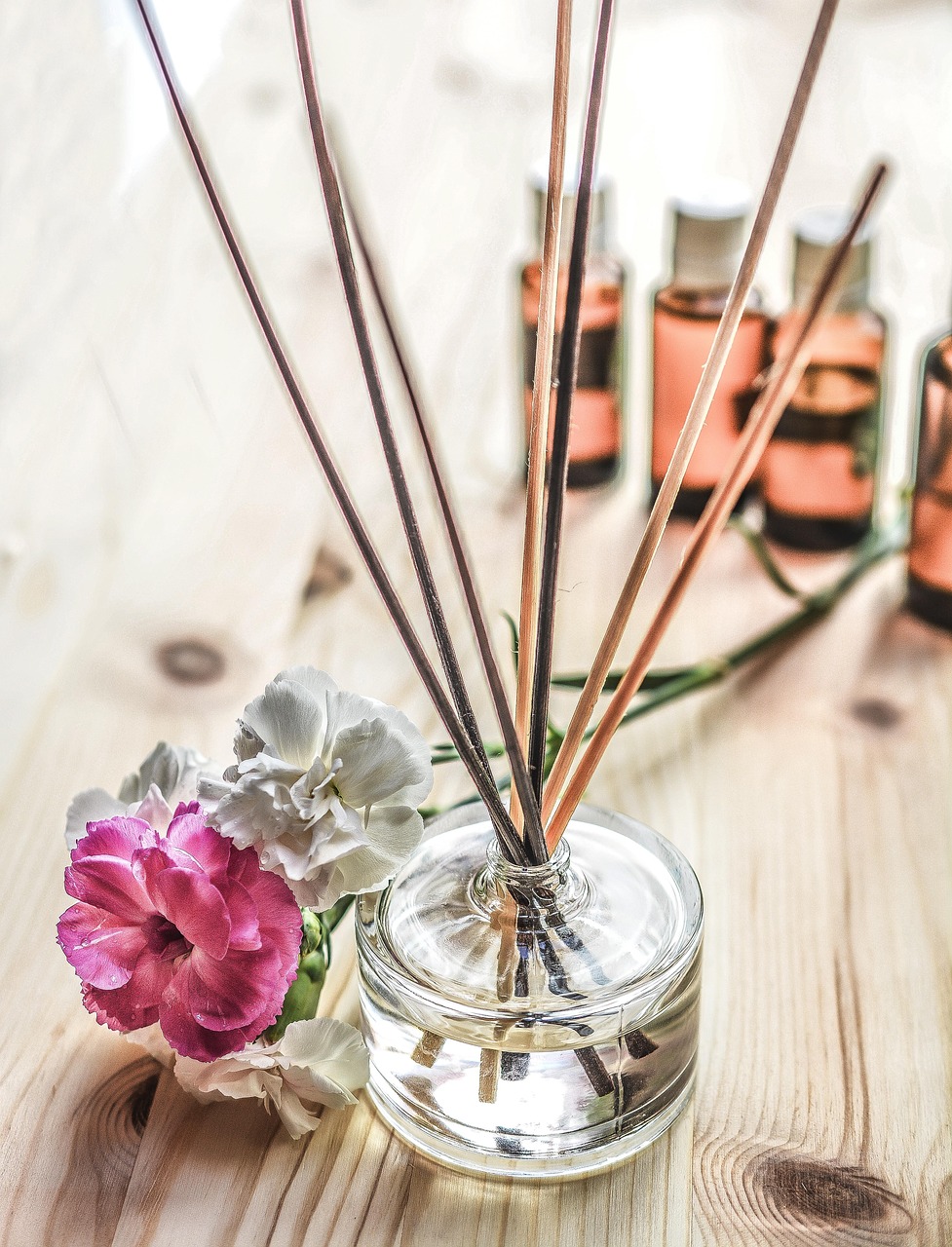
Not every scenting format requires a spray bottle. Cajeput works well in unglazed clay diffuser stones, reed diffusers, and scented sachets. For a reed diffuser, combine cajeput with a carrier oil (fractionated coconut oil or dipropylene glycol are commonly used) at roughly a 30:70 ratio. Pour into a narrow-mouthed bottle with 6 to 8 reed sticks. Flip the reeds every few days to refresh the scent throw.
5. Steam, Sauna, and Shower Scenting
Of all the cajeput oil uses in the home, steam-based applications may be the most sensory-rich. There is something deeply satisfying about standing in a hot shower with cajeput's crisp, foresty scent rising with the steam around you. It transforms an ordinary routine into something that feels intentional and restorative.
Shower Scenting
The simplest method: place 3 to 5 drops of cajeput oil on the floor of your shower (away from where water hits directly) or on a small, unglazed clay tile in the corner. As the hot water runs and steam fills the space, the heat releases the oil's volatile compounds. The effect is immediate and enveloping.
Alternatively, place a few drops on a small cloth or shower bomb tablet on the ledge near the water stream but not in it. This extends the scent duration slightly compared to direct tile application.
Safety note: Do not apply undiluted cajeput oil to your skin. Do not let undiluted oil pool where it could be stood in. The floor of a shower can become slippery if oil accumulates. Use minimal amounts and position them away from foot-contact areas.
Sauna Use
Cajeput has long been used in sauna traditions. A diluted blend of cajeput in water (4 to 6 drops per 500 ml of water) can be ladled carefully over sauna rocks to produce a scented steam. The high heat vaporizes the oil rapidly, creating an intensely aromatic burst that fills the sauna in seconds.
A few cautions for sauna use:
- Always dilute in water before applying to rocks. Pure essential oil on hot sauna stones can ignite.
- Keep the amount modest. A small amount in a large volume of water is sufficient. More is not better in a confined, hot space.
- Ensure adequate ventilation. Concentrated aromatic steam in an enclosed space can cause irritation for some individuals, particularly those with scent sensitivities.
- Those with young children, during pregnancy, or with known respiratory sensitivities should consult a qualified healthcare provider before using essential oils in steam environments.
Cajeput blends particularly well with birch tar, eucalyptus, and pine in sauna applications, creating a layered, forest-floor atmosphere that many enthusiasts describe as the quintessential sauna scent.
Steam Bowl Ritual
A steam bowl is a simple, low-equipment way to enjoy cajeput without a shower or sauna. Fill a large bowl with hot (not boiling) water. Add 2 to 3 drops of cajeput essential oil. Lean over the bowl at a comfortable distance, drape a towel loosely over your head and the bowl, and breathe in the rising steam for 5 to 10 minutes.
This is a popular evening or cold-weather wind-down ritual. The warmth of the steam combined with cajeput's clean, clarifying scent creates an atmosphere of genuine calm.
Safety note: Keep your face at least 30 to 40 cm from the water surface to avoid steam burns. Do not use water that has just come off the boil. Keep eyes closed during the session. Not recommended for young children without direct adult supervision and healthcare provider guidance.
For a complete look at how to use cajeput in steam environments, including more advanced sauna blending techniques, read our guide on cajeput oil in the shower and sauna: steam-friendly scenting.
6. Blending Guide: What Pairs Well With Cajeput
Understanding how to blend cajeput is what separates routine use from genuinely beautiful home scenting. Cajeput is a middle-to-top note with enough character to anchor a blend, but enough restraint to support other oils without overpowering them. Here is a structured overview of its most successful pairings.
Citrus Pairings
Cajeput and citrus oils are natural partners. The green, slightly fruity undertone in cajeput acts as a bridge between citrus's brightness and the fuller, deeper notes you might add as a base. Lemon is the most intuitive pairing: clean, uplifting, and universally pleasing. Bergamot adds a floral-tea quality that softens cajeput's camphoraceous edge. Grapefruit brings an effervescent, almost sparkling quality to the combination.
Suggested ratio for a citrus-cajeput blend: 40% cajeput, 40% citrus (single or combined), 20% base note such as cedarwood or sandalwood.
Herbal and Minty Pairings
Cajeput shares a chemical and olfactory kinship with many herbal oils. Peppermint intensifies the cooling, clarifying character of cajeput dramatically, creating a blend that feels invigorating and very clean. Use peppermint carefully, as it is potent; 1 to 2 drops to every 4 drops of cajeput is usually sufficient. Spearmint is gentler and produces a sweeter result. Rosemary adds a herbal depth that grounds the blend without pulling it in a medicinal direction.
Floral Pairings
Cajeput's slightly sweet mid-note means it can work with florals more successfully than eucalyptus, which tends to clash. Lavender is the classic companion: the pairing creates a clean-fresh-calm atmosphere that works in nearly any room. Geranium adds a rosy-green complexity that elevates cajeput's natural character. Ylang-ylang, used sparingly (1 drop goes a long way), introduces a lush, exotic warmth that transforms cajeput entirely.
Woody and Resinous Pairings
Base notes give cajeput staying power and help its brighter top notes settle into a room rather than dissipating immediately. Cedarwood (Virginian or Atlas) is a reliable anchor: earthy, warm, slightly pencil-shaving, and grounding. Frankincense adds a sacred, resinous quality that pairs beautifully with cajeput in contemplative settings. Vetiver is a bolder choice: its deep, smoky earthiness contrasts sharply with cajeput's brightness, creating a complex, unusual blend that some people find compelling and others find challenging. Test small amounts first.
Spice Pairings
Clove and cajeput share botanical heritage as both are significant in the aromatics traditions of Indonesia and the Maluku islands. The combination is warm, slightly sharp, and deeply evocative of spice-route history. Cardamom adds a sweeter, more approachable spice note. Ginger root introduces a zesty warmth that bridges the gap between cajeput's freshness and the depth of resinous base notes.
Blend Recipes at a Glance
| Blend Name | Oils and Drops (per 10 ml) | Best Room |
|---|---|---|
| Island Morning | Cajeput 4, Bergamot 3, Cedarwood 2, Ylang-ylang 1 | Living room, morning |
| Crisp Focus | Cajeput 4, Rosemary 3, Peppermint 2, Lemon 1 | Home office, daytime |
| Evening Forest | Cajeput 2, Lavender 4, Frankincense 2, Vetiver 1 | Bedroom, evening |
| Spice Route | Cajeput 3, Clove bud 2, Cardamom 3, Sandalwood 2 | Entryway, autumn-winter |
| Coastal Linen | Cajeput 3, Lemon 4, Geranium 2, Cedarwood 1 | Bedroom, bathroom, spring-summer |
All blend quantities above are for a 10 ml roller or diffuser blend bottle. For diffuser use, use 4 to 8 drops total from any blend. Adjust ratios freely: blending is experiential, and your nose is the final arbiter.
7. Sourcing and Quality: What to Look For
Cajeput oil quality varies more than many buyers expect. The market is not heavily regulated, and substitution or adulteration with cheaper cineole-rich oils is not unheard of. Knowing what to look for protects your investment and ensures you are working with a genuinely aromatic, well-produced oil.
Botanical Labeling
The label on any cajeput oil you purchase should state the Latin name clearly: Melaleuca cajuputi. This distinguishes it from the broader range of paperbarks and confirms you are not getting a generic "cajeput-type" oil blended from various sources. Some suppliers also note the plant part (leaves and twigs) and the extraction method (steam distillation). Both are useful confirmations of transparency.
Country of Origin
Most commercial cajeput comes from Indonesia, with the islands of Buru and Seram being historically significant production centers. Australian cajeput from wild-harvested northern territory material is also available and tends toward a slightly sharper, more complex aromatic profile. Vietnamese cajeput exists as well, though it is less commonly encountered in the retail essential oil market. None of these origins is inherently superior to another; the quality depends far more on distillation practices than geography alone.
GC/MS Testing
Gas chromatography-mass spectrometry (GC/MS) testing is the gold standard for verifying essential oil composition. Reputable suppliers provide these reports, either on request or published directly on their website. For cajeput, look for a 1,8-cineole content roughly in the range of 50 to 70 percent, with alpha-terpineol as a notable secondary constituent. Cineole content significantly below this range may indicate a poor-quality distillation or substitution. Significantly above it could suggest blending with eucalyptus oil.
Packaging and Storage
Quality cajeput should be packaged in dark glass (amber or cobalt) to protect it from light degradation. Avoid any supplier offering cajeput in clear glass or plastic. Once you receive your oil, store it upright in a cool, dark place. Cajeput's top notes can oxidize over time, particularly if the bottle is frequently opened and exposed to air. A properly stored oil in a sealed dark-glass bottle should remain fragrant and useful for 2 to 3 years.
Price as a Signal
Cajeput is not an expensive oil to produce. If you encounter cajeput priced significantly below market average for a 10 ml bottle, treat this as a signal worth investigating. Extremely cheap cajeput may be cut with a carrier, adulterated with synthetic cineole, or simply old stock. Equally, there is no reason cajeput should be priced at the same level as rare florals or costly resins. A fair price reflects honest sourcing and proper production, not artificial scarcity.
8. Tradition, Culture, and the Paperbark Story
Using cajeput oil in your home connects you, perhaps more directly than you realize, to one of the oldest ongoing aromatic traditions in the world. The oil's story does not begin in a modern distillery. It begins in the coastal swamps and monsoon forests of the Maluku islands, where the paperbark tree has been a source of material culture, fragrance, and ceremonial significance for centuries.
Kayu Putih: Indonesia's Everyday Essential Oil
In Indonesia, minyak kayu putih (cajeput oil) is a household staple with a cultural presence that most Western essential oil users would find remarkable. It is not an artisanal or specialty product in its home country. It is as common as paracetamol in a Western medicine cabinet, used daily by families across generations for a remarkable range of domestic purposes. The brand Cap Lang, which has produced kayu putih in Indonesia since 1978, is one of the most recognized consumer products in the archipelago.
This ubiquity reflects a longstanding relationship between Indonesian communities and the paperbark tree. The oil was traditionally obtained through rudimentary steam distillation in village-level operations, and the knowledge of when to harvest, how long to distill, and how to assess quality was passed down within families and communities over generations.
The Paperbark in Australian Indigenous Culture
In Australia, paperbarks (including but not limited to Melaleuca cajuputi) hold profound significance for many Aboriginal communities. The bark itself has been used for shelter construction, as a wrapping material for food in earth ovens, for making containers and canoes, and as a surface for ceremonial and artistic expression. The trees themselves are markers of water in arid and semi-arid landscapes, and their distinctive white trunks have made them navigation references and gathering places across many different Country groups.
The essential oil industry's interest in Australian cajeput is relatively recent, and some producers are beginning to work in partnership with indigenous land managers and communities to develop harvest protocols that respect both ecological sustainability and cultural significance. When purchasing Australian-sourced cajeput, it is worth asking whether and how the supplier engages with indigenous stakeholders.
To go deeper into the cultural and ceremonial context of cajeput and paperbark, our dedicated article on cajeput oil in ritual and tradition: paperbark lore explores this history in much greater detail.
Cajeput in Global Trade History
Cajeput oil entered European awareness via Dutch colonial trade networks in the seventeenth century. Dutch traders sourcing spices and aromatics from the Maluku islands encountered cajeput oil as a local commodity with clear commercial potential. By the eighteenth century, it was appearing in European pharmacopeias and trade catalogs alongside more familiar botanicals. This history of global trade is part of why cajeput carries both the practical familiarity of an everyday oil and the quiet exoticism of something that has traveled a long way to reach your diffuser.
9. Safety, Dilution, and Responsible Use
No guide to how to use cajeput oil is complete without a thorough safety section. Cajeput is a generally well-tolerated essential oil when used correctly. That qualification matters. Essential oils are potent, concentrated aromatic compounds, and cajeput is no exception.
Dilution Guidelines
The following dilution rates are based on widely cited aromatherapy safety guidelines. Always work within these ranges unless you have specific guidance from a qualified aromatherapist.
| Application | Recommended Dilution | Notes |
|---|---|---|
| Diffusing (per session) | 3 to 8 drops in diffuser water | 30 to 60 min max per session; ventilate room |
| Room/linen spray | 0.5 to 1% (5 to 10 drops per 100 ml) | Shake before use; test on fabric first |
| Body application (adult) | 1 to 2% in carrier oil | Patch test 24 hours before broad use |
| Steam bowl | 2 to 3 drops per large bowl of hot water | Keep distance; keep eyes closed |
| Sauna ladle blend | 4 to 6 drops per 500 ml water | Never apply undiluted oil to rocks |
Patch Testing
Before using any diluted cajeput preparation on skin, perform a patch test. Apply a small amount of the diluted preparation to the inside of your forearm or the crook of your elbow. Cover loosely with a bandage. Wait 24 hours. If you notice redness, itching, or irritation, do not proceed with skin use and consult a qualified healthcare provider. Sensitivity reactions are individual and unpredictable; a patch test is the only way to establish your personal response.
Populations Requiring Extra Caution
- Pregnant and breastfeeding individuals: Essential oil safety during pregnancy and breastfeeding is a specialized area. Consult a qualified healthcare provider before using cajeput during these periods.
- Infants and young children: Cajeput contains 1,8-cineole, which is not considered appropriate for use near the faces of children under 10 years of age, and should be used with significant caution for children of any age. Keep diffuser use minimal and in well-ventilated spaces if children are present. Always consult a pediatrician before using cajeput around young children.
- Those with scent sensitivities: Cajeput's strong aromatic compounds can cause irritation for individuals with sensitivities. Start with minimal amounts and well-ventilated spaces.
- Pets: Many essential oils, including cineole-rich oils, can be harmful to cats and dogs. Ensure pets can leave any diffused space freely. Consult a veterinarian before using cajeput oil in spaces regularly occupied by pets.
General Safety Principles
- Never ingest cajeput oil. It is for aromatic and topical use only.
- Keep all essential oils stored out of reach of children.
- Do not apply undiluted cajeput oil directly to skin.
- Avoid contact with eyes and mucous membranes.
- If skin contact with undiluted oil occurs, dilute immediately with a carrier oil (not water, which can drive the oil further into skin) and wash with soap and water. Seek advice from a healthcare provider if irritation persists.
- This guide does not constitute medical advice. Always consult a qualified healthcare provider with health-related questions or concerns.
Bringing It All Together: A Home-Scenting Practice With Cajeput
Cajeput essential oil is one of those rare aromatics that reveals more depth the longer you spend with it. Its first impression is simplicity: clean, fresh, bright. But as you work through the room-by-room applications, the blending possibilities, and the steam rituals, something more layered emerges. This is an oil with a story that spans centuries and continents, a genuinely complex aromatic character, and a practical flexibility that few single-source botanicals can match.
Building a home-scenting practice with cajeput does not require a cabinet full of expensive equipment. A quality bottle of oil, a basic diffuser, a spray bottle, and a handful of complementary oils will take you through seasons and moods with ease. Start with the simpler applications: a lemon-cajeput blend in the diffuser on a weekday morning, a few drops on the shower floor on a cold evening. Let your familiarity with the scent grow before reaching for more complex blends.
And when you are ready to go deeper, whether into the steam rituals, the spice-route blends, or the layered history of this quietly remarkable tree, the guides linked throughout this article are here to take you further.
Fresh air, properly sourced, beautifully blended: that is the promise of cajeput in your home.