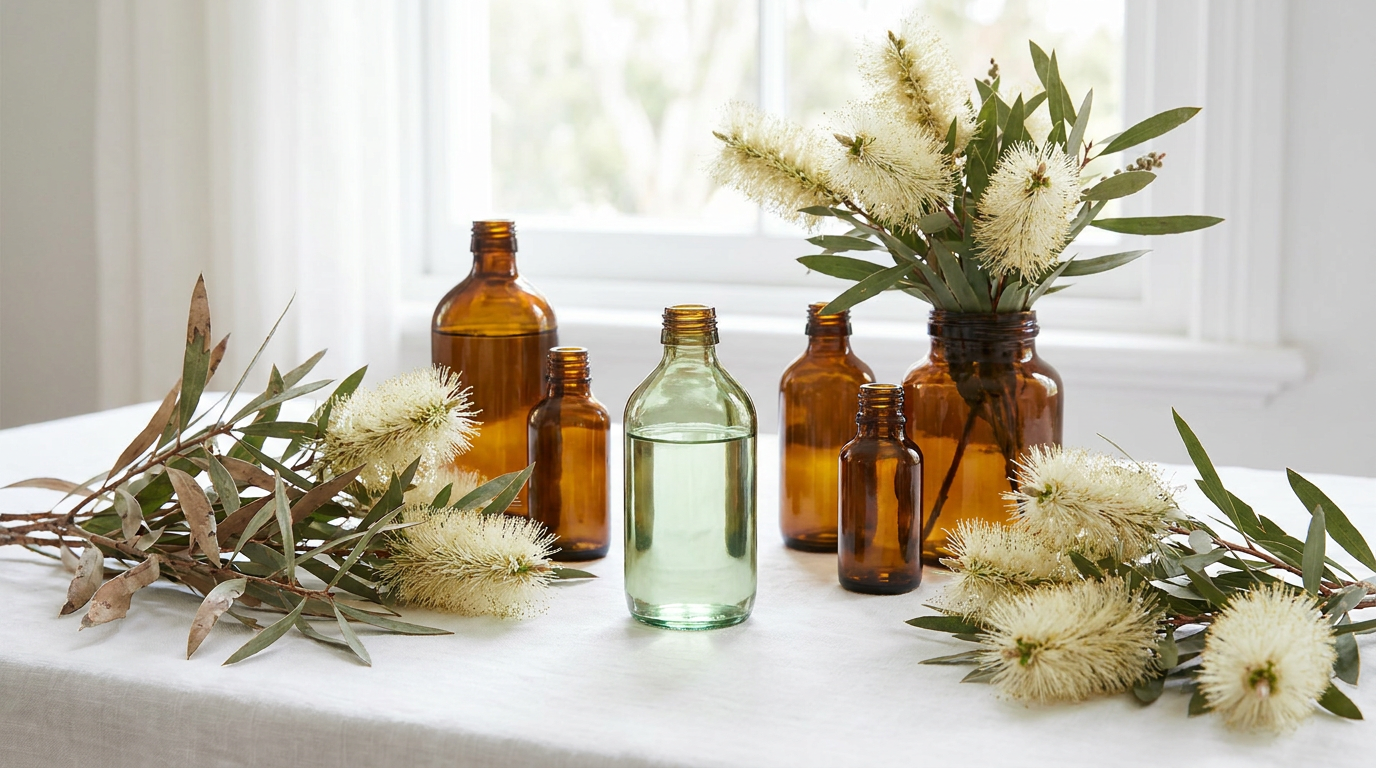
Cajeput Oil vs Camphor Oil: Two Camphoraceous Classics Compared
Walk down the aisle of any well-stocked essential oil shop and you'll notice a family resemblance between certain bottles before you even open them. Cajeput and camphor oil both belong to that sharp, cool, faintly medicinal-smelling group aromatherapists call "camphoraceous." They show up in the same diffuser blends, the same cleaning sprays, and the same conversations about which oil to reach for when you want a bracing, clean scent in a room. But they come from different trees, carry different chemical profiles, and are not interchangeable in every situation. This guide lines them up side by side so you can decide which one belongs on your shelf, or whether you need both.
Cajeput Essential Oil
Our own Cajeput Essential Oil, in sizes from 0.5 oz to bulk.
From $10.99
Shop Now →What Makes an Oil "Camphoraceous"?
In aromatherapy language, "camphoraceous" describes a scent category, not a single compound. It refers to that crisp, penetrating, almost cool-to-the-nose quality you smell in eucalyptus, rosemary, camphor, and cajeput oil alike. Chemically, oils in this family tend to be rich in oxides and ketones, compounds that evaporate quickly and carry a sharp top note. That's why camphoraceous oils are popular in blends meant to feel invigorating rather than soft or floral. Cajeput and camphor oil sit at the center of this category, which is exactly why people so often ask how they differ.
Cajeput Oil at a Glance
Cajeput oil is steam distilled from the leaves and twigs of Melaleuca cajuputi, a paperbark tree native to Southeast Asia and parts of Australia, sometimes marketed as "island-fresh paperbark" oil for its bright, breezy character. The tree is a cousin of tea tree and niaouli, part of the same botanical family, which explains why cajeput's aroma carries a faint eucalyptus-and-tea-tree kinship alongside its camphoraceous edge.
The oil itself is pale yellow to nearly colorless, thin in viscosity, and known for a fresh, slightly fruity-green top note layered over that classic cool sharpness. Traditionally used for aromatic and cosmetic purposes across Indonesia, Malaysia, and the Philippines, cajeput has a long folk history in massage oils, room sprays, and steam inhalation rituals, though modern buyers mostly reach for it as an aromatic and cosmetic ingredient rather than anything else. Its main aromatic constituent is 1,8-cineole, the same compound that gives eucalyptus its signature brightness.
Camphor Oil at a Glance
Camphor oil is distilled from the wood, root, and branches of the camphor laurel tree, Cinnamomum camphora, native to East Asia and now cultivated in several subtropical regions. Unlike cajeput, camphor oil is sold in a few distinct types, and this matters more than most buyers realize. White camphor oil, which has had the higher-risk compounds removed during rectification, is the type generally used in cosmetic and aromatic products. Brown and yellow camphor oil contain much higher levels of a compound called safrole and are not considered appropriate for cosmetic or aromatic use, so reputable suppliers will clearly label which type you're buying.
White camphor oil is colorless to very pale, thin, and carries an intensely sharp, almost snappy coolness, more piercing than cajeput's rounder brightness. It has a long history in balms, chest rubs, and cooling body products across many cultures, and today it's most often found in small percentages within blended cosmetic formulas, cleaning products, and diffuser mixes rather than used on its own at full strength.
Cajeput vs Camphor Oil: Side-by-Side Comparison
| Attribute | Cajeput Oil | Camphor Oil (White) |
|---|---|---|
| Botanical source | Melaleuca cajuputi | Cinnamomum camphora |
| Plant family | Myrtaceae | Lauraceae |
| Part distilled | Leaves and twigs | Wood, root, branches |
| Primary growing regions | Indonesia, Malaysia, Vietnam, Philippines | China, Taiwan, Japan, Madagascar |
| Color | Pale yellow, sometimes near-colorless | Colorless to very pale |
| Scent character | Fresh, bright, slightly fruity-green camphoraceous top note | Sharp, piercing, intensely cool camphoraceous note |
| Key aromatic compound | 1,8-cineole (typically 45 to 65 percent) | Camphor (typically 30 to 40 percent in white type) |
| Viscosity | Thin, watery | Thin, watery |
| Typical topical dilution | 1 to 2 percent in a carrier oil for general blends | 0.5 to 1 percent in a carrier oil for general blends |
| Sensitivity notes | Generally well tolerated at low dilution; patch test recommended | Higher sensitization potential; patch test strongly recommended, lower dilution advised |
| Common applications | Diffuser blends, room sprays, massage oil blends, soap and candle scenting | Diffuser blends, chest-style balms, cleaning sprays, camphorwood-style scenting |
| Typical price range | Budget to mid-range | Mid-range (white type costs more than brown or yellow, which are avoided anyway) |
| Shelf life (properly stored) | 2 to 3 years | 2 to 3 years |
Pros and Cons
Cajeput Oil
Pros:
- Brighter, more rounded aroma that blends easily into citrus, mint, and herbal combinations
- Generally considered gentler on skin at recommended dilutions, making it a common pick for massage oil blends
- Widely available and reasonably priced compared to many specialty botanicals
- Single, consistent commercial type, so there's no label confusion the way there is with camphor's white, yellow, and brown variants
Cons:
- Less piercing and cooling than camphor oil, so it may not satisfy people specifically chasing that ultra-sharp top note
- Some batches carry a faint sulfurous undertone if distillation quality is inconsistent
- Still needs proper dilution and a patch test before broader skin use, like any concentrated essential oil
Camphor Oil
Pros:
- Delivers the most intensely cooling, classic camphoraceous aroma of the two, prized in cleaning blends and cold-weather diffuser mixes
- Long-standing traditional use in balm-style and rub-style cosmetic products across multiple cultures
- Small amounts go a long way in a blend, since the aroma is so concentrated
Cons:
- Comes in multiple types (white, yellow, brown), and buyers must confirm they're purchasing white camphor oil specifically for cosmetic and aromatic use
- Generally considered more likely to cause skin sensitivity, so lower dilution ratios are advised
- Not appropriate for young children, and anyone pregnant, nursing, or managing an existing health condition should check with a qualified healthcare provider before use
- Should never be taken internally under any circumstances
A quick honesty note on sourcing: cajeput and camphor oil are both easy to adulterate with synthetic cineole or camphor because those compounds are cheap to produce in a lab. Buy from suppliers who publish GC-MS testing results for each batch, not just a generic "pure and natural" label.
Safety Considerations for Both Oils
Camphoraceous essential oils are potent, and "natural" does not mean risk-free. A few general practices apply to both cajeput and camphor oil:
- Dilute before skin contact. Neither oil should touch skin undiluted. A 1 to 2 percent dilution (roughly 6 to 12 drops per ounce of carrier oil) is a reasonable starting point for cajeput; camphor oil is generally used at a lower 0.5 to 1 percent dilution given its stronger sensitization profile.
- Patch test first. Apply a small diluted amount to the inner forearm and wait 24 hours before using either oil more broadly.
- Keep away from the face, eyes, and mucous membranes. Both oils are sharp enough to cause noticeable discomfort in these areas even at low concentrations.
- Never ingest. Both oils are intended for aromatic and topical cosmetic use only.
- Store safely away from children and pets. Concentrated essential oils can be harmful if swallowed.
- Check the type when buying camphor oil. Only white camphor oil is generally considered appropriate for cosmetic or aromatic use; yellow and brown types are not.
- Talk to a qualified healthcare provider before using either oil if you are pregnant, nursing, managing an existing health condition, or introducing it to a young child's environment.
Best For: Use Case Recommendations
Choose Cajeput Oil If You Want:
- An everyday diffuser staple. Its brighter, more rounded profile plays well with citrus and mint oils for a daily-use blend that doesn't feel overwhelming.
- A gentler option for massage oil blends. Its comparatively lower sensitization profile makes it a common choice among massage and spa formulators working at low dilutions.
- A budget-friendly camphoraceous note. Cajeput tends to run less expensive than white camphor oil while still delivering that fresh, cool character.
- Simplicity in sourcing. There's only one commercial type to shop for, unlike camphor's multi-type landscape.
Choose Camphor Oil If You Want:
- Maximum coolness and sharpness. If a blend calls for that classic, piercing camphor note, cajeput's softer profile won't fully replicate it.
- A cleaning-spray or household-blend ingredient. Camphor's intensity means a few drops carry a room, which suits DIY surface sprays and closet fresheners.
- A traditional balm-style aroma. If you're recreating a classic rub-style or balm-style cosmetic product, camphor oil is the more historically accurate note.
- You're comfortable with careful dosing. Camphor rewards a light hand, and people who enjoy precise, low-percentage blending will get the most out of it.
Cajeput Oil as an Alternative to Camphor
One of the most common questions in this comparison is whether cajeput oil can simply stand in for camphor oil. As a cajeput oil alternative to camphor, the honest answer is: partially. Both oils share that oxide-and-ketone-driven camphoraceous backbone, and in blends where camphor is playing a supporting role rather than the star note, cajeput can often be swapped in at a similar or slightly higher percentage without dramatically changing the overall effect. This is especially useful for people who find camphor's sharper intensity a bit much on the skin, or who want to avoid navigating camphor's white, yellow, and brown type distinctions altogether.
Where the swap falls short is in blends specifically built around camphor's piercing, almost menthol-adjacent snap. Cajeput's fruitier, rounder edge softens that effect rather than replicating it. If a recipe leans on camphor for its signature bite, expect a noticeably gentler final result when substituting cajeput, not an identical one. Formulators who want the best of both sometimes blend the two together in small ratios, letting cajeput round out camphor's sharper edges rather than replacing it outright.
Verdict: Which Should You Buy?
For most home users building a first camphoraceous essential oils collection, cajeput oil is the more forgiving, more versatile starting point. It's gentler at the dilutions most people actually use, simpler to shop for since there's no type confusion, and priced accessibly enough to experiment with across diffuser blends, room sprays, and low-dilution massage oil recipes.
Camphor oil earns its keep for a narrower but real purpose: when a blend genuinely needs that sharp, cooling intensity that cajeput can't quite match. Reach for white camphor oil specifically, buy from a supplier who tests and labels type clearly, and use it sparingly.
In practice, many people who love the camphoraceous family end up keeping both bottles on the shelf: cajeput for daily, easygoing use, and a small bottle of white camphor oil reserved for the blends that call for its distinctive punch. Neither oil replaces the other completely, and that's precisely what makes them worth comparing rather than choosing between once and for all.